
Learning Auto Repair Without a Tuition Bill in Minneapolis
A tuition estimate can end an automotive career before it starts. Plenty of young adults here love pulling engines apart on weekends. Then a school hands them a payment plan with five figures on it, and the whole idea stalls out.
- Auto tech certificate programs cost about $25,870 on average in tuition and fees.
- Newgate students pay nothing at all, with no tuition, no fees, and no loans.
- Car donations fund the entire school, so students learn on real vehicles instead of textbooks.
Auto Mechanics Training Program
What Auto Tech Training Usually Runs
Trade school isn't cheap, and auto programs sit near the top of the range. Federal IPEDS data puts the average cost of an auto tech certificate at roughly $25,870 in tuition and fees. Across trade schools, average annual tuition and fees were closer to $15,070 in 2022-23. Then come the extras. A starter tool set. Books. Uniforms. Test fees. The real bill climbs fast.
Now look at the paycheck. Auto techs earned a median wage of $49,670 in May 2024, per the Bureau of Labor Statistics. Borrowing half a year's pay before your first shop job is a rough way to start a career.
Trade School Costs Side by Side With Newgate
| What You Pay For | Typical Trade School | At Newgate School |
| Tuition and fees | About $25,870 for a typical auto program | $0 |
| Student loans | Often needed to fill the gap | None |
| Books | Bought by the student | Donated cars are the coursework |
| Tools | Usually out of pocket | Tool cabinet at graduation |
| High school diploma | Usually required | Not required |
| Time to finish | 1 to 2 years, fixed schedule | 12 to 18 months, your pace |
| How you learn | Lectures plus lab hours | 100% hands-on shop work |
| Job placement | Varies by school | 95% to 100% placement rate |
| Who pays the bills | Tuition, fees, aid, loans | Donated vehicle sales |
| Who can enroll | Anyone who can pay | Ages 19 to 35, Twin Cities metro |
Where the Money Actually Comes From
So is trade school free? Rarely. Our vehicle donation program that supports free trade schools has been operating since 1981. Our founder built a funding model nobody else was using at the time. People around the Twin Cities donate cars, trucks, vans, and SUVs. Students fix them as part of training. Some of those vehicles get sold, and every dollar goes back into the school. No tuition. No fees. No bill in the mail.
The shop never runs dry, either. Each donated car shows up with its own set of problems. That's exactly what a student needs to learn: brakes, suspension, welding, paint prep, and body work.
What We Ask From Students Instead
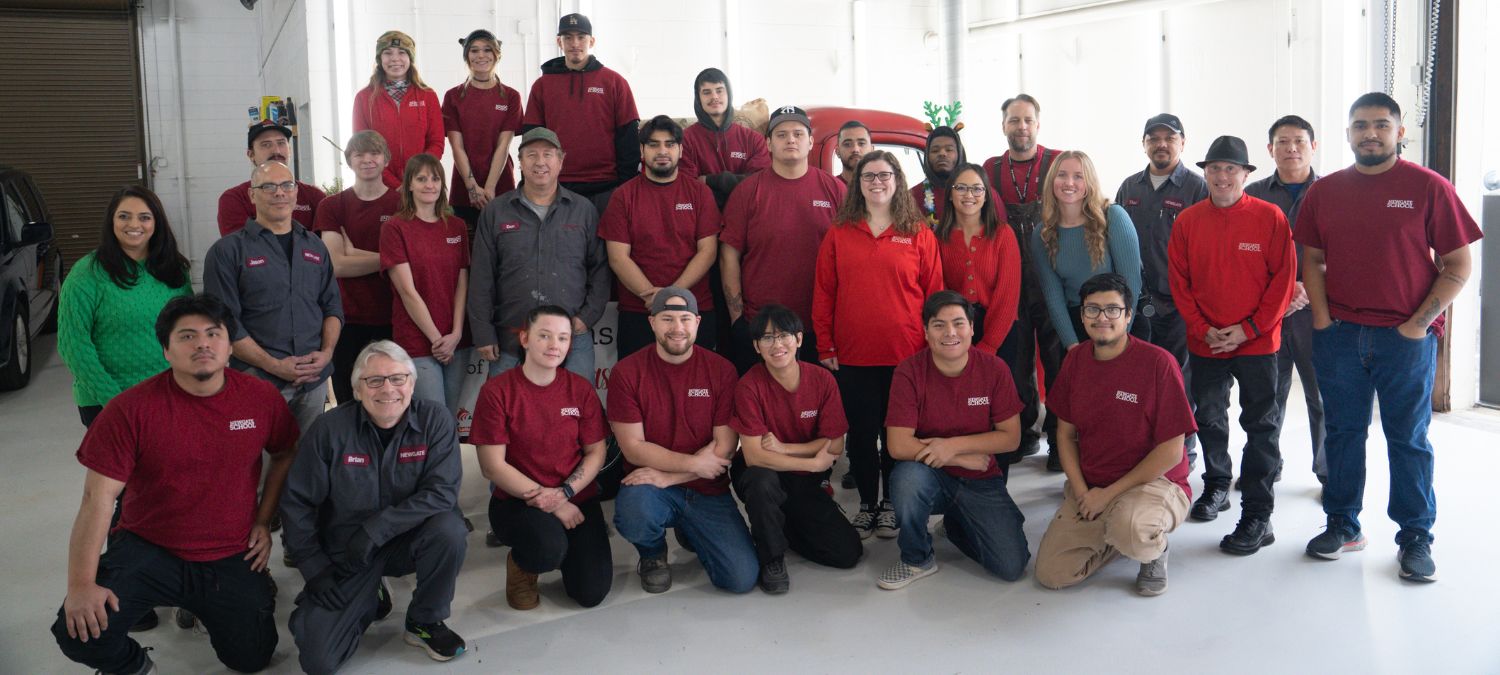
Nothing here is free of effort. Students show up, work full days in the shop, and stay with it for a year or more. Some walk in having never held a torque wrench. Others grew up handing tools to a parent under a raised hood. Both types finish. All we ask is that you keep showing up and keep learning.
What Students Walk Out With
Grads leave with a certificate and a tool cabinet stocked for their trade. Nearly all of them have a job lined up at a local shop or dealership. Our placement rate runs between 95% and 100%. Shops around town already know what our training looks like, so they hire from us. Most students finish in 12 to 18 months. Auto mechanics takes about a year. Auto body runs a bit longer. Both programs move at your pace, not a set calendar.
Who We Look For
Most of our students are 19 to 35, live on a low income, and want a real career fixing cars. No high school diploma? That's fine with us. Our founder said it plainly years ago. We look at ability and attitude, not paperwork. Two instructors run each program, so nobody gets lost in the shuffle. Students who struggled in a classroom often take off once the lesson happens under the hood.
Starting a Trade Without Starting in Debt
A tuition-free start changes the math on a whole career. A grad earning near that $49,670 median keeps the full check. Nothing will be routed to a loan servicer for the next 10 years. That head start turns into a reliable car, then an apartment, then maybe a house. Spots fill up quickly, so call early and get your name in.
Why Newgate School Is Worth a Visit
We'd rather show you the shop than talk about it. Give us a call, and we'll set up a time for you to come by. Walk the floor. Watch a student pull a transmission or block-sand a quarter panel. Sit down with an instructor and figure out which program fits you. Ask about the application, the timeline, and what a first job out of here tends to look like. Fifty years of training students here taught us one thing. Most people make up their minds the moment they smell the shop and see someone their own age doing the work.
Common Questions About Tuition-Free Auto Training
Do students really pay nothing?
Yes. Accepted students owe no tuition and no fees. There's nothing to finance and nothing to pay back later.
Do I need a high school diploma to get in?
No. A diploma isn't required. We look at whether you want the work and whether you'll stick with it.
How long does the training take?
Most students graduate in 12 to 18 months. Auto mechanics takes roughly a year, and auto body usually runs a little longer.
What do graduates earn starting out?
Pay depends on the shop and your experience. Nationally, auto service techs earned a median of $49,670 in May 2024, and auto body and glass repairers earned $50,680, per the Bureau of Labor Statistics.
How does a school with no tuition stay open?
Donated vehicles. People give us cars, students repair them during training, and 100% of the sale proceeds go back into the school.
Who qualifies to apply?
Applicants are generally 19 to 35, living on a lower income, and living in the seven-county Twin Cities metro. Call us and we'll walk you through the rest.